
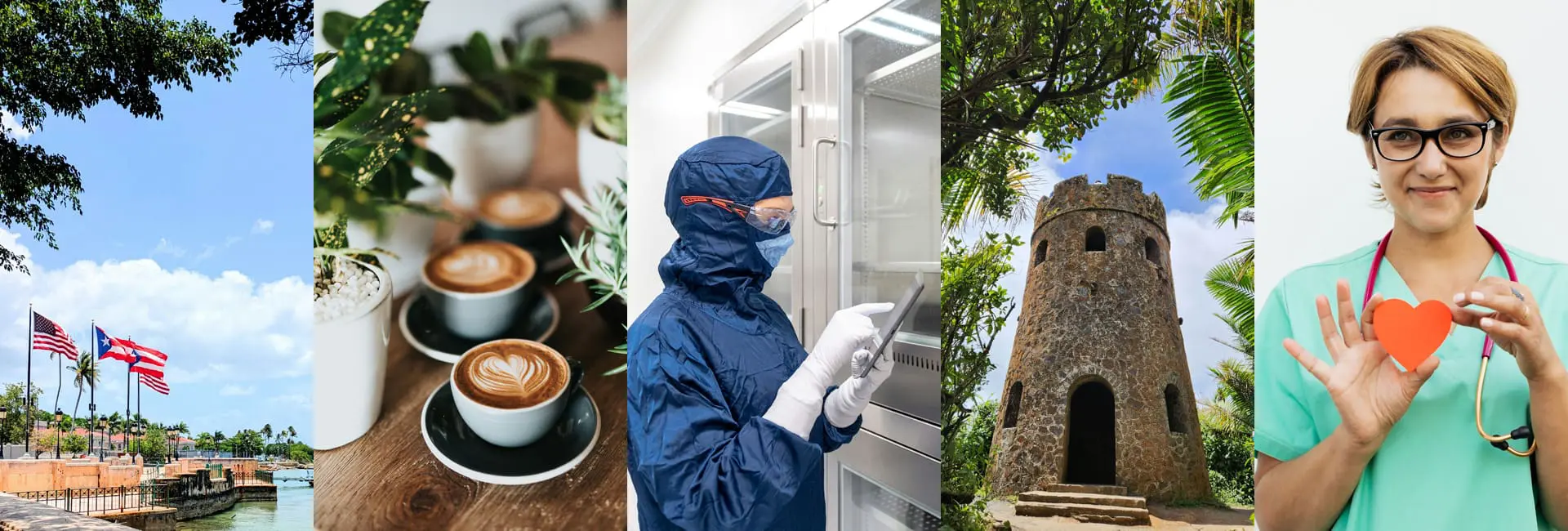
Puerto Rico’s economy is recovering but still fragile – 2024 estimates are $121B Nominal GDP and $39,353 per capita GDP, with tourism accounting for 7-13% of output, depending on the way contribution is measured. PROMESA was established in 2016 to provide federal fiscal oversight, and the island remains under this oversight today, a decade after the 2015–2016 debt crisis began. Economic conditions vary sharply across the island’s regions, from pharmaceutical hubs to agricultural zones.
Key Industries
Pharmaceuticals and medical-device manufacturing remain the backbone of Puerto Rico’s export economy – the island is one of the largest pharmaceutical manufacturing hubs under the U.S. flag. Tourism, covered throughout this guide, is a fast-growing second pillar. Finance and Act 60–driven investment services are a smaller but rapidly growing niche. Agriculture, once dominant (sugar, coffee, tobacco), is now a minor share of GDP, though coffee and rum remain culturally significant exports – see the sections of this guide about Foods & Drinks, Rum Producers, and Coffee Haciendas for more information.
The Debt Crisis
Decades of deficit borrowing, tax-incentive expirations (including the 2006 phase-out of Section 936 federal tax breaks that had anchored the island’s manufacturing base), and slow growth led to a 2015–2016 debt crisis and the largest municipal bond default in U.S. history. Congress responded with PROMESA (2016), creating a federal Financial Oversight and Management Board that still supervises the commonwealth’s budget and debt restructuring today.
See Government for how this oversight board fits into Puerto Rico’s political structure, and read about Act 60 for the newest chapter of the island’s economic story.
Economy by Region
The island-wide numbers in this section hide huge local variation – this following breaks down what drives each region’s economy.
| Region | Dominant Economic Driver |
|---|---|
| Metro (San Juan, Bayamón, Guaynabo, Carolina) | Finance, government, corporate headquarters, tourism, the island’s main airport and cruise port |
| North (Manatí, Barceloneta, Vega Baja) | Pharmaceutical and biotech manufacturing – one of the highest concentrations of pharma plants under the U.S. flag |
| East (Fajardo, Humacao, Vieques, Culebra) | Tourism, marinas, ferry/boating industry, resort real estate |
| South (Ponce, Guayama, Salinas) | Historic sugar/shipping wealth (Ponce), energy generation, growing solar development |
| West (Mayagüez, Aguadilla, Rincón) | Fishing, surf tourism, agriculture, some manufacturing legacy around Mayagüez |
| Central Mountains (Jayuya, Adjuntas, Utuado, Yauco) | Coffee agriculture, small-scale farming, growing agrotourism |
This is a directional regional overview, not a municipality-by-municipality economic census – granular local data (unemployment, median income, per-municipality GDP) is available from Puerto Rico’s Institute of Statistics.