 David
David What It Is, Who Qualifies, and Why It’s Suddenly in the News
If you’ve heard people talk about a “Puerto Rican citizenship certificate” and wondered whether that’s a real thing, it is, and right now it’s at the center of a legislative fight that could change who can get one going forward. I’ve been getting questions about this from readers for weeks, so I wanted to lay out exactly what it is, why people apply for it, and what’s happening in the legislature right now.
What Is a Puerto Rican Citizenship Certificate?
 The Certificado de Ciudadanía Puertorriqueña is an official document issued by the Puerto Rico Department of State. It confirms that you hold Puerto Rican citizenship, a status recognized under local law, separate from and alongside your U.S. citizenship. You qualify either because you were born on the island or because you can trace your lineage back to it.
The certificate is governed by Regulation No. 7347, adopted in 2007. That regulation spells out exactly how the Department of State evaluates and issues these certificates. It’s also the regulation currently under threat from a repeal bill that’s already cleared one chamber of the legislature. I’ll walk through that a bit further down.
Why People Actually Apply for This
I’ve noticed two very different groups of people request this certificate, and it’s worth understanding both if you’re deciding whether it’s worth your time.
- Some apply purely out of pride. It’s a formal, government issued acknowledgment of Puerto Rican heritage, something to pass down or keep as proof of where the family line begins. If that’s you, this certificate is the closest thing Puerto Rico has to a citizenship paper trail, and for a lot of families, that matters on its own.
- Others are applying with Spain in mind. Under Spain’s Civil Code (Article 22.1), nationals of Ibero American countries can apply for Spanish citizenship after just two years of legal residence instead of the standard ten. Puerto Rico has been treated as an Ibero American territory for this purpose since a 2007 Spanish government resolution. No Spanish law technically requires the certificate itself, but it’s become the document Spanish civil registries rely on to confirm eligibility. If you’re pursuing that fast track to Spanish citizenship, this certificate is what smooths the process.
What Regulation 7347 Actually Requires
Article IV of Regulation 7347 is the part that matters most if you’re applying. It lays out exactly who qualifies and what you must prove, recognizing four paths to eligibility:
- Born in Puerto Rico, proven with your birth certificate
- U.S. citizen with a Puerto Rican parent, proven with your birth certificate plus your parent’s Puerto Rican birth certificate (this path is generally limited to one generation of descent)
- U.S. citizen who has lived in Puerto Rico for at least one consecutive year before applying.
- By court declaration, in cases that fall outside the first three categories
Whichever path applies to you, you’ll need to back it up with the required documents below. Article IV is what ties your eligibility category to the paperwork the Department of State will accept.
Is the Certificate Going Away? Here’s the Current Status
As of late August 2026, not yet, but it’s close. House Joint Resolution 348, which would repeal Regulation 7347, passed the Puerto Rico House of Representatives on August 20, 2026, by a 32 to 11 vote. It’s now sitting in the Senate, where no committee action has been taken yet, and it hasn’t gone anywhere near the Governor’s desk.
If it eventually becomes law, the bill would:
- Order the Department of State to stop issuing new certificates.
- Repeal Regulation 7347 within 60 days of the law taking effect.
- Grandfather in every certificate already issued. The bill explicitly states existing certificates “shall not be revoked, annulled or invalidated.”
- Still process any complete applications filed before the cutoff date.
So, if you already have your certificate, it stays valid no matter what happens next. If you’re thinking about applying, my candid advice is don’t wait to find out. And if you’re applying with that Spanish citizenship pathway in mind, there’s a real open question worth knowing about: Spain hasn’t yet said what documentation it will accept from future Puerto Rican applicants who never got a certificate. Nobody has that answer yet, me included.
I’ll be updating this post as the Senate takes it up, so check back if this affects you.
Required Documents
- A certified, recent birth certificate. Use the blue form version if you were born on the island, or your parent’s Puerto Rican birth certificate if you’re applying through ancestry.
- A valid, government issued photo ID (passport or driver’s license both work).
- Proof of payment: a $30 comprobante de rentas internas, an internal revenue stamp from Puerto Rico’s own Department of Treasury (Hacienda). This is a Puerto Rico stamp, not anything from the U.S. Internal Revenue Service, so don’t go looking for it there.
- The completed application and sworn statement, submitted to the Department of State.
How to Apply
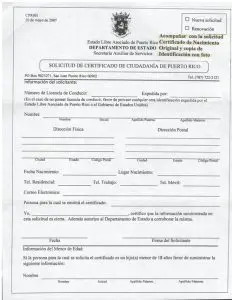
Here’s the part that trips people up: the application isn’t posted for direct download on the Department of State’s own site. You can find the official form, known as CPR001, here: Solicitud de Certificado de Ciudadanía Puertorriqueña (PDF). Completed applications go to the Division of Certifications at the Department of State.
If you’d like help with the process, or want an English translation of the application, reach out to me. I’m happy to walk you through it.
Official sources: Reglamento Núm. 7347 (Puerto Rico Department of State) · Puerto Rico Department of State
Legislative status current as of August 31, 2026. Because this bill is actively moving through the Senate, treat the legislative section as a snapshot, not a permanent record. I’ll keep it updated.